

Itinerary Building 101: Multi-City Planning UX That Converts

Multi-city search exposes the limits of traditional flight pricing.
While many travel platforms invest heavily in improving booking interfaces, the real constraint often sits beneath the user experience. Multi-city searches are more complex than simple round-trip itineraries, and when pricing logic is rigid, even a well-designed interface struggles to produce competitive results.
For travel platforms, the challenge is not primarily UX. It is fare construction.
If the underlying logic cannot construct stronger itineraries, the interface simply surfaces those limitations.
The structural constraint of traditional fare construction
Most flight search platforms still rely on traditional single-PNR fare construction. In this model, the entire itinerary must conform to one pricing structure. All segments are bound together within the same fare rules, combinability logic, and pricing constraints.
This approach simplifies ticketing, but it limits optimization.
When every segment must comply with a single fare structure, platforms lose the ability to improve pricing through segment-level fare construction. The result is often a narrow set of itinerary options and weaker price competitiveness, even when multiple platforms are selling the same underlying airline content.
For mid-to-large OTAs, this creates a familiar problem: they have access to the same inventory as competitors, but their pricing outcomes are less competitive.
The limitation is structural.
How FareStructure changes itinerary construction
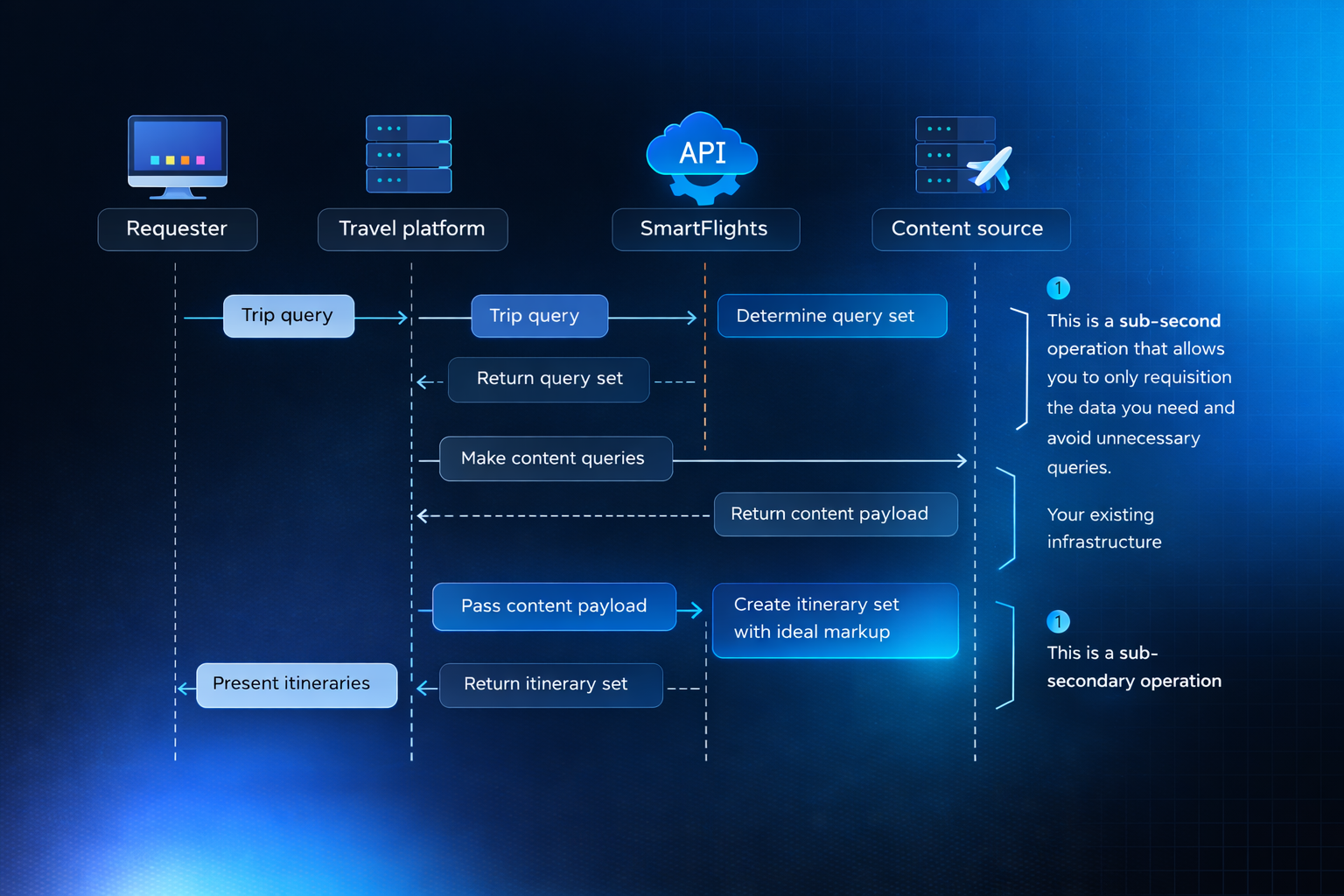
SmartFlights FareStructure addresses this constraint by automating structured split-ticket construction across flight searches. Instead of forcing all segments into a single-PNR model, FareStructure evaluates fare rules and combinability conditions across segments and constructs compliant itineraries designed to produce stronger pricing outcomes.
This does not mean segments from different itineraries can be freely mixed. Each itinerary returned by SmartFlights is a validated construction, priced and structured as a complete option. The platform can present transparent pricing across the segments of that itinerary, but those segments remain tied to the itinerary structure that generated them.
This ensures fare rule compliance while enabling more flexible fare construction than traditional single-PNR pricing allows.
The impact becomes measurable in pricing performance.
The economics of structured fare construction
SmartFlights FareStructure has demonstrated strong pricing advantages in real search environments.
Across analysed itineraries:
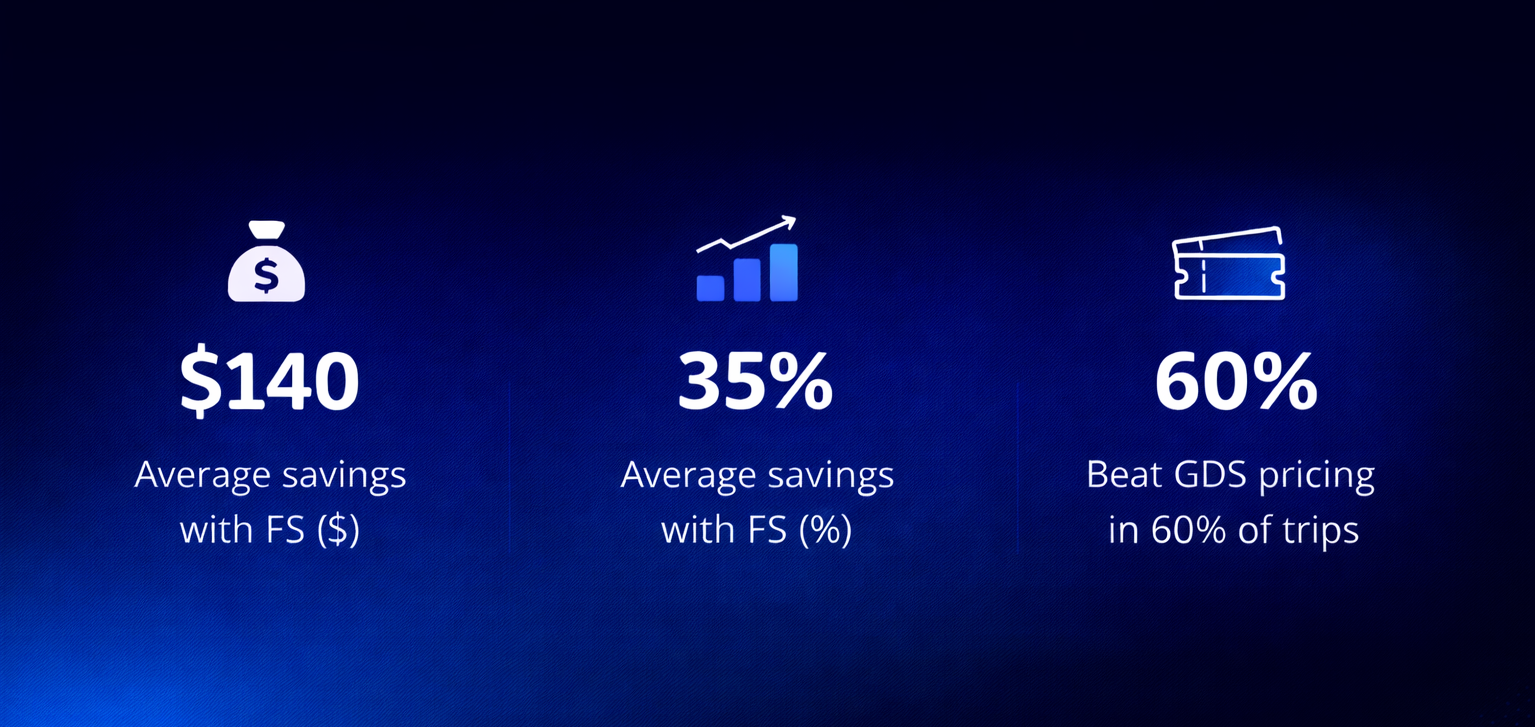
Pricing improves by an average of 35 percent
FareStructure beats traditional GDS pricing in 60 percent of trips
These gains are not simply about offering cheaper tickets. They create commercial flexibility for travel platforms.
When an itinerary is structurally more competitive, an OTA can decide how to use that advantage. Some of the savings may be passed through to the traveller to improve conversion rates. Some may be retained to increase contribution margin. Many platforms apply a balanced strategy that supports both.
The key point is that this margin flexibility does not require additional supplier contracts or increased acquisition spending.
It comes from stronger fare construction.
Why better fare construction improves conversion
Multi-city searches place more scrutiny on pricing consistency than simple itineraries.
Travellers compare multiple options across several cities, airlines, and departure times. When pricing differences between similar itineraries appear inconsistent or difficult to rationalize, trust declines. Even technically valid itineraries can feel uncertain if the pricing outcomes appear unpredictable.
When fare construction improves, the booking experience becomes clearer.
Platforms can present itineraries that are competitively priced, logically structured, and easier for travellers to evaluate. Pricing breakdowns can be shown transparently because each itinerary is constructed and validated as a coherent whole.
UX influences conversion. Fare construction determines the economic value of the options being presented.
Margin control through markup-by-itinerary
Another important advantage of structured fare construction is the ability to apply markup-by-itinerary strategies.
Instead of applying uniform markups across routes or carriers, platforms can adjust margins at the itinerary level. When FareStructure produces a pricing advantage, the platform can decide how much of that advantage should be retained or passed through to the traveller.
This creates a more sophisticated revenue model. Platforms gain the ability to maintain competitive fares while preserving margin where pricing flexibility exists.
For OTAs operating in highly competitive markets, this control can materially improve search monetization efficiency.
Different value across platform types
The commercial impact of FareStructure varies slightly across platform segments, but the underlying advantage is the same: stronger pricing outcomes from existing fare inventory.
Mid-to-large OTAs benefit by improving price competitiveness without needing new inventory agreements. Even when selling the same airline content as competitors, better fare construction allows them to surface stronger itineraries and capture more bookings.
Flight consolidators and wholesalers benefit by extracting more value from complex fare structures, including private fares that are often underutilized when combinability logic is limited.
Corporate travel platforms can also benefit selectively. In these environments, the priority is often cost control within policy boundaries. Structured fare logic can surface cheaper compliant options without requiring changes to supplier relationships or travel policies.
Across all segments, the advantage comes from improving the economic output of search rather than simply increasing search volume.
Multi-city planning as revenue architecture
The travel industry is entering a phase where growth is increasingly constrained by efficiency. Customer acquisition costs continue to rise, and surface-level interface improvements are quickly replicated by competitors.
Structural pricing intelligence is harder to copy.
Platforms that improve revenue per search gain a durable advantage. By strengthening fare construction, they turn itinerary building into a form of revenue architecture rather than simply a search function.
In a market where acquisition costs rise annually, improving revenue per search through structured fare intelligence is not optimization.
It is strategic defence.
Travel platforms that treat itinerary construction as infrastructure rather than interface design will convert more high-intent travellers, protect margin, and compete on structural advantage rather than cosmetic differentiation.
Multi-city planning is not just a UX challenge.
It is a monetization opportunity.
Let’s talk growth
Trip Ninja helps travel platforms drive bookings, increase margins, and stay competitive with smarter, AI-driven solutions.


.png)
16 Travel Tech & Itinerary Planning Trends Shaping 2026
2026 travel tech trends: AI trip planning, hyper-personalization, NDC, mobile-first booking, sustainable tools, biometrics, AR/VR, and stronger security.

What to Expect in Travel in 2026: Key Trends in Airfare and OTA Platforms
2026 travel trends are reshaping OTAs: strong demand, value-driven travelers, AI-powered booking, NDC distribution, and fierce competition across platforms.
What to Look Forward to at ITB Asia 2025
Top 10 things to look forward to at ITB ASIA 2025, ITB Asia returns to Singapore with three shows under one roof: ITB Asia, MICE Show Asia, and Travel
.png)
Revolutionizing Travel Booking: How Trip Ninja Leverages Machine Learning to Outperform Traditional GDS Systems
Trip Ninja leverages machine learning to optimize routes, enable dynamic pricing, and personalize travel bookings, outperforming traditional GDS systems.
.png)
Unlocking New Routes: How Virtual Interlining Benefits Travellers and OTAs
Discover the benefits of VI and the role of technology in enabling VI in every day itineraries that matter to budget-conscious travellers.
.png)
Top 5 Multi-City Flight Booking Trends to Watch in 2025
Top 5 multi-city flight trends for 2025: regional travel, AI personalization, sustainability, mobile-first bookings, and emerging market growth. Stay ahead with

Virtual Interlining FAQs: Meeting Consumer Demands with Affordable and Flexible Itineraries
Looking for answers about Virtual Interlining? We explore some FAQs about VI in our latest blog.
.png)
Thriving in 2025: The Ultimate Preparation Guide for Your Online Travel Agency
Prepare your OTA for 2025 with tips on scaling operations, smarter marketing, tech adoption, and cybersecurity to stay ahead in a competitive market!
.png)
The Ultimate Guide to Virtual Interlining for Online Travel Agencies in 2025
Give your customers more choices and better prices with Virtual Interlining. Trip Ninja makes it easy for OTAs to offer smarter, seamless travel in 2025.
.png)
Simplify Financial Reporting: A Comprehensive Step-by-Step Guide for OTAs
The Ultimate Guide to Streamlining Financial Reporting for OTAs: Leverage automation, integration, and clear frameworks to boost profitability and efficiency
.png)
.png)