

What to Expect in Travel in 2026: Key Trends in Airfare and OTA Platforms
As we enter 2026, the travel industry is forging ahead with strong demand while navigating a landscape of new challenges and innovations. Online Travel Agencies (OTAs) and travel platform leaders, from CEOs to product directors, face a pivotal year to capitalize on pent-up travel demand and technological advances. This forward-looking overview examines the major trends in airfare, traveler behavior, and technology shaping the travel sector globally. The goal is to help industry decision-makers anticipate what is next and position their platforms as market leaders. We explore economic factors such as inflation and fuel costs, technology developments including AI, NDC, and personalization, and shifting consumer habits, backed by recent data rather than speculation. Visual aids such as charts and graphs are included to highlight key points.
Robust Travel Demand Amid Economic Headwinds
Travel Rebounds Globally
The global travel industry continued its post-pandemic rebound through 2025 and is expected to surpass pre-2019 levels in 2026. Total travel bookings worldwide were projected at approximately $1.67 trillion in 2025, extending beyond pre-pandemic benchmarks. Travel and tourism GDP is on track to exceed $11.7 trillion, representing roughly 10 percent of global GDP, with 371 million jobs supported. This recovery is fueled by consumers’ enduring desire to travel.
Importantly, travel remains on a growth path despite economic headwinds. Even with inflation and high interest rates, leisure and business travelers continue to prioritize experiences over possessions, keeping travel demand resilient. Travel has become a protected budget category for many consumers, which bodes well for 2026.
Record Air Passenger Numbers
In aviation, 2026 is poised to set new records. The International Air Transport Association forecasts 5.2 billion air passengers in 2026, a 4.4 percent increase from 2025. This surpasses the 2019 pre-pandemic peak of 4.5 billion passengers. Airlines are expected to fill approximately 83.8 percent of seats on average, the highest load factor ever recorded, as capacity growth struggles to keep pace with demand.
This demand is constrained by supply issues such as aircraft delivery delays and pilot shortages, which means flights are frequently operating at or near full capacity.
Airfares and Costs
Airfares are expected to remain elevated, though not dramatically higher than in 2025. IATA projects the average round-trip fare will increase slightly to $402 in 2026. Despite perceptions of high prices, airfares remain nearly 37 percent lower than in 2015 on average, driven by efficiency gains and competition.
Fuel prices are providing some cost relief. Jet fuel is forecast to average around $88 per barrel in 2026, down slightly from 2025 levels. However, fuel still represents roughly a quarter of airline operating costs and remains a significant risk factor should oil markets shift.
Profitability and Constraints
Airline profitability is improving, though margins remain thin. Global airlines are expected to generate approximately $41 billion in net profit in 2026, representing a 3.9 percent margin. Revenues are forecast to reach $1.1 trillion, growing faster than expenses. Rising labor, maintenance, and regulatory costs continue to pressure margins, and many airlines are still barely covering their cost of capital.
Supply chain bottlenecks, regulatory fees, and geopolitical disruptions remain persistent challenges. Aircraft shortages continue to constrain capacity growth, contributing to high load factors across global networks.
Regional Variations
The recovery is uneven across regions. Asia-Pacific is leading growth, with passenger demand expected to rise 7.3 percent in 2026, driven by China’s outbound recovery and regional travel growth. North America and Europe are entering a slower growth phase, with demand growth in the low single digits. European carriers are expected to post strong profitability by maintaining disciplined capacity growth and benefiting from robust intra-European leisure travel.
Hotel pricing trends also vary widely. In early 2026, hotel prices in Asia and the Middle East are up approximately 9 percent year over year, while Oceania has experienced an 11 percent decline. These regional disparities highlight the need for localized pricing and sourcing strategies rather than a one-size-fits-all global approach.
Evolving Traveler Behavior
Traveler behavior in 2026 reflects a balance between strong desire to travel and heightened sensitivity to value, safety, and purpose.
Travelers are increasingly adjusting destinations and timing rather than cancelling trips. Many are choosing less crowded destinations or traveling during shoulder seasons to reduce costs and avoid congestion. Surveys indicate that more than one-third of travelers actively seek less crowded destinations, while nearly one-third plan to travel outside peak periods.
Shorter booking windows are becoming more common, particularly in North America, where a growing share of bookings occur within one month of travel. Currency fluctuations are also shaping travel flows, as destinations with weaker currencies attract more inbound travelers.
Experiences continue to outweigh material purchases in consumer priorities. Travelers increasingly seek trips aligned with personal interests, wellness, and cultural immersion. At the same time, spending behavior is polarizing, with some travelers splurging on premium components while aggressively seeking savings elsewhere.
Sustainability and wellness remain influential factors, particularly among younger and higher-income travelers. Safety, flexibility, and geopolitical awareness also play a growing role in destination choice and booking behavior.
Technology Transforming Travel
Technology is moving from experimentation to scaled deployment in 2026.
AI-driven trip planning and customer service adoption continues to grow, with more travelers using conversational interfaces to research and compare travel options. AI is increasingly moving from inspiration to execution, enabling transactional booking through conversational interfaces.
Operationally, AI is improving revenue management, pricing optimization, customer service efficiency, and predictive maintenance. Hybrid AI-human service models are becoming standard as companies seek to balance automation with quality support.
Personalization is advancing through unified data platforms and real-time analytics. Attribute-based selling, dynamic offers, and tailored recommendations are gaining traction across airlines and hospitality providers.
NDC has become mainstream in airline distribution, enabling richer content, dynamic pricing, and personalized offers through third-party channels. Payment innovation, including digital wallets and buy-now-pay-later options, is reducing friction and expanding affordability.
Sustainability technologies and policies are also gaining importance, though progress remains gradual, particularly in areas like sustainable aviation fuel adoption.
Competition and the OTA Landscape
Online booking channels continue to dominate, with OTA growth strongest in Asia-Pacific markets. Competitive boundaries are blurring as social platforms, search engines, and AI interfaces increasingly facilitate bookings.
AI-driven discovery presents both a risk and an opportunity for OTAs. Platforms that integrate with AI systems and expose inventory through robust APIs are better positioned to remain relevant as booking interfaces evolve.
Consolidation, partnerships, and vertical integration continue as major players seek to expand capabilities and improve customer retention. User experience, personalization, and service quality are increasingly critical differentiators.
Travel in 2026 will be defined by strong demand, heightened competition, and accelerating technological change. Travelers remain eager to explore, but they are more value-conscious, flexible, and intentional in how they travel. Technology, particularly AI and modern distribution systems, is reshaping how trips are planned, booked, and serviced.
For travel platforms and OTAs, success in 2026 will depend on agility, data-driven decision-making, and customer-centric innovation. Platforms that balance efficiency with personalization, integrate seamlessly across channels, and adapt quickly to shifting traveler expectations will be best positioned to lead in the next phase of travel’s evolution.
Let’s talk growth
Trip Ninja helps travel platforms drive bookings, increase margins, and stay competitive with smarter, AI-driven solutions.



Itinerary Building 101: Multi-City Planning UX That Converts
This is how OTAs can use AI-driven flight composition to build cheaper itineraries, improve pricing competitiveness, and increase traveller conversions.
.png)
16 Travel Tech & Itinerary Planning Trends Shaping 2026
2026 travel tech trends: AI trip planning, hyper-personalization, NDC, mobile-first booking, sustainable tools, biometrics, AR/VR, and stronger security.
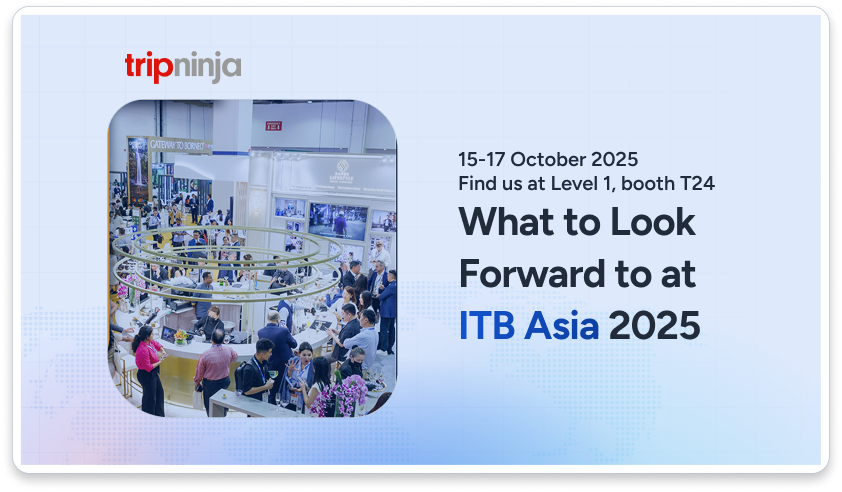
What to Look Forward to at ITB Asia 2025
Top 10 things to look forward to at ITB ASIA 2025, ITB Asia returns to Singapore with three shows under one roof: ITB Asia, MICE Show Asia, and Travel
.png)
Revolutionizing Travel Booking: How Trip Ninja Leverages Machine Learning to Outperform Traditional GDS Systems
Trip Ninja leverages machine learning to optimize routes, enable dynamic pricing, and personalize travel bookings, outperforming traditional GDS systems.
.png)
Unlocking New Routes: How Virtual Interlining Benefits Travellers and OTAs
Discover the benefits of VI and the role of technology in enabling VI in every day itineraries that matter to budget-conscious travellers.
.png)
Top 5 Multi-City Flight Booking Trends to Watch in 2025
Top 5 multi-city flight trends for 2025: regional travel, AI personalization, sustainability, mobile-first bookings, and emerging market growth. Stay ahead with

Virtual Interlining FAQs: Meeting Consumer Demands with Affordable and Flexible Itineraries
Looking for answers about Virtual Interlining? We explore some FAQs about VI in our latest blog.
.png)
Thriving in 2025: The Ultimate Preparation Guide for Your Online Travel Agency
Prepare your OTA for 2025 with tips on scaling operations, smarter marketing, tech adoption, and cybersecurity to stay ahead in a competitive market!
.png)
The Ultimate Guide to Virtual Interlining for Online Travel Agencies in 2025
Give your customers more choices and better prices with Virtual Interlining. Trip Ninja makes it easy for OTAs to offer smarter, seamless travel in 2025.
.png)
Simplify Financial Reporting: A Comprehensive Step-by-Step Guide for OTAs
The Ultimate Guide to Streamlining Financial Reporting for OTAs: Leverage automation, integration, and clear frameworks to boost profitability and efficiency
.png)
.png)